Shopper Re-Engagement Framework

Triangulating data from audits, analytics, and UX research to find ways to re-engage Facebook Marketplace shoppers.
Context
Organization
The goal of the Facebook Marketplace Buyer Growth team was to find ways to increase the size of Marketplace’s user base. We had multiple tactics for this, including expanding to new international markets. However, beyond acquiring new users, a potent source of increased engagement was prior users who had left the platform and not come back. This represented a large opportunity, as there were many users who would visit Marketplace once or a few times, then not re-visit.
Historically, the team had implemented various approaches to try to re-engage shoppers, but these had been implemented ad-hoc, without an underlying strategy tying them together or even a record of all the ways we currently tried to re-engage shoppers. The impetus for this research, therefore, was to lay the foundation for an effective re-engagement strategy.
Goals
Business goal: Re-engage shoppers who previously visited Marketplace and have not come back.
Research goals: Understand current re-engagement practices and develop a research perspective on how to prioritize investments, including new opportunities.
Team
My role: Research lead & project manager
Partners: Engineer, designers, data scientist
Stakeholders: Product manager, designers, engineer, data scientist
Study Design
Method
To lay the foundation for a future re-engagement strategy, I wanted as many types of insights as possible. We had a great deal of prior UX research on user needs and pain points across the shopper journey and with notifications (a major re-engagement channel). However, we had not examined:
What were all the different ways we currently tried to re-engage shoppers (i.e., the current landscape)?
How well did those tactics support shopper needs across the journey?
How did our methods for re-engagement compared with competitors?
Which re-engagement channels were more vs. less effective at generating click-throughs?
My goal was to bring all of these data points together and distill them into a digestible point of view. Thus, the methods became product audits (Marketplace and competitors), analytics review, and literature review.
Sample
N/A; no net new UX research conducted.
Tools
Internal analytics, Mural, Google Suite
Process
Parallel Work
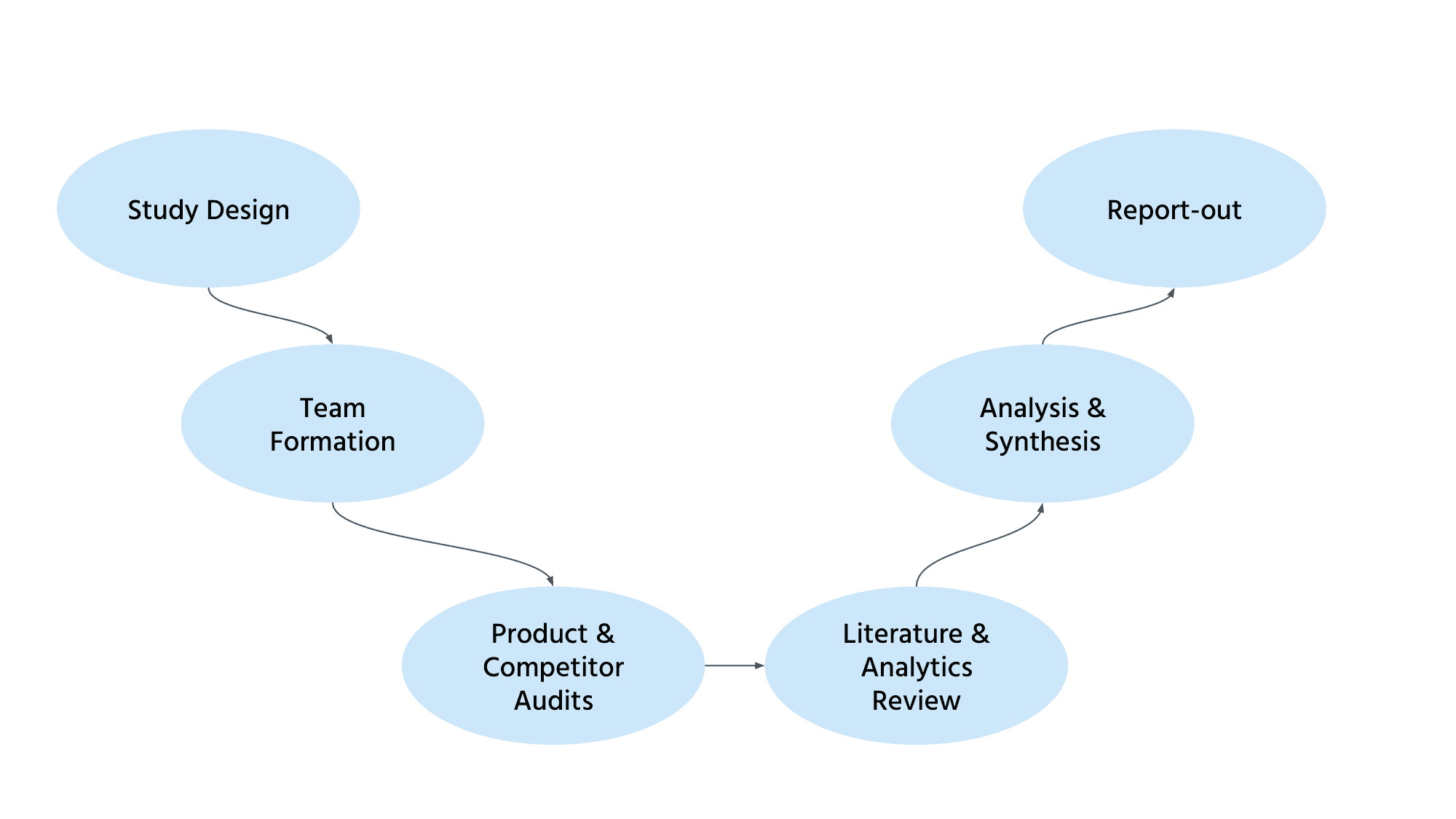
To speed up the process and build buy-in for the results, I engaged stakeholders as active participants in data collection. Each discipline contributed in a different way based on their expertise:
I reviewed insights from prior UX research, going broad (i.e., user needs and pain points throughout the shopper journey) and deep (i.e., re-engagement needs and pain points specifically).
My engineering partner, who had a lot of historical knowledge about the team's prior work, outlined our current re-engagement tactics. This provided a critical lay of the land and informed the first project deliverable.
My design partners kicked off a competitor audit to see how our competitors were re-engaging customers.
Lastly, my data science partner reviewed analytics to determine click-through rates for each re-engagement channel.
I then brought all the data together during synthesis.
Synthesis
After analyzing data from each method individually, I connected the dots by mapping the data points to the various stages of the shopper journey. This approach enabled me to interpret the data from the lens of shopper needs and pain points, so that the ultimate framework would be user-centered.
Key Insights
Literature Review
Re-engagement should support user goals and alleviate user pain points across the shopper journey.
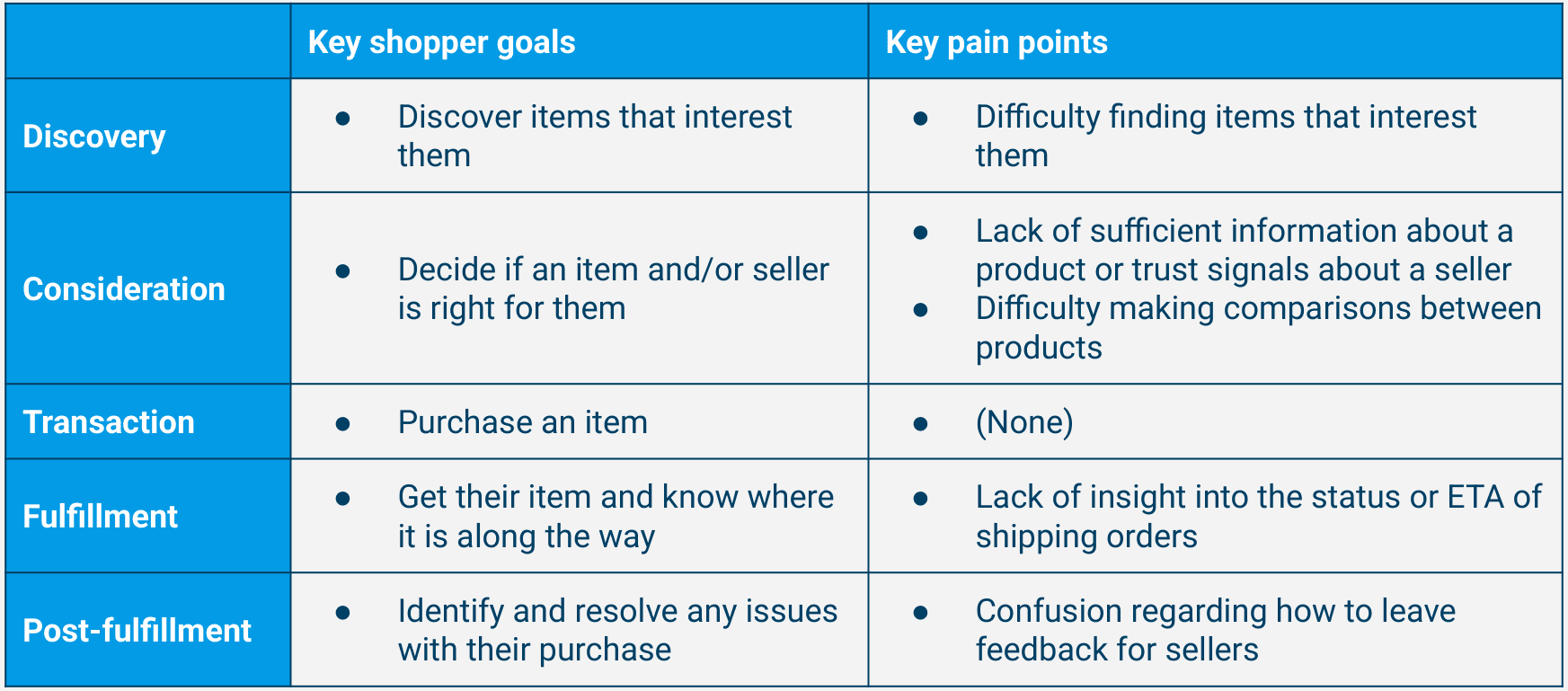
Approaching re-engagement from the perspective of user needs and pain points was essential for an effective strategy. Prior research had shown the key stages of the shopper journey, as well as goals and pain points associated in each stage.
Notifications (a key re-engagement channel) should be related to high-intent, potential purchases.
In prior studies, the most useful notifications were those related to updates about saved and explored listings. Research has shown that in general, notifications should be important, seen, relevant, non-redundant, controllable, and surfaced at the appropriate level (based on urgency).
Product Audit
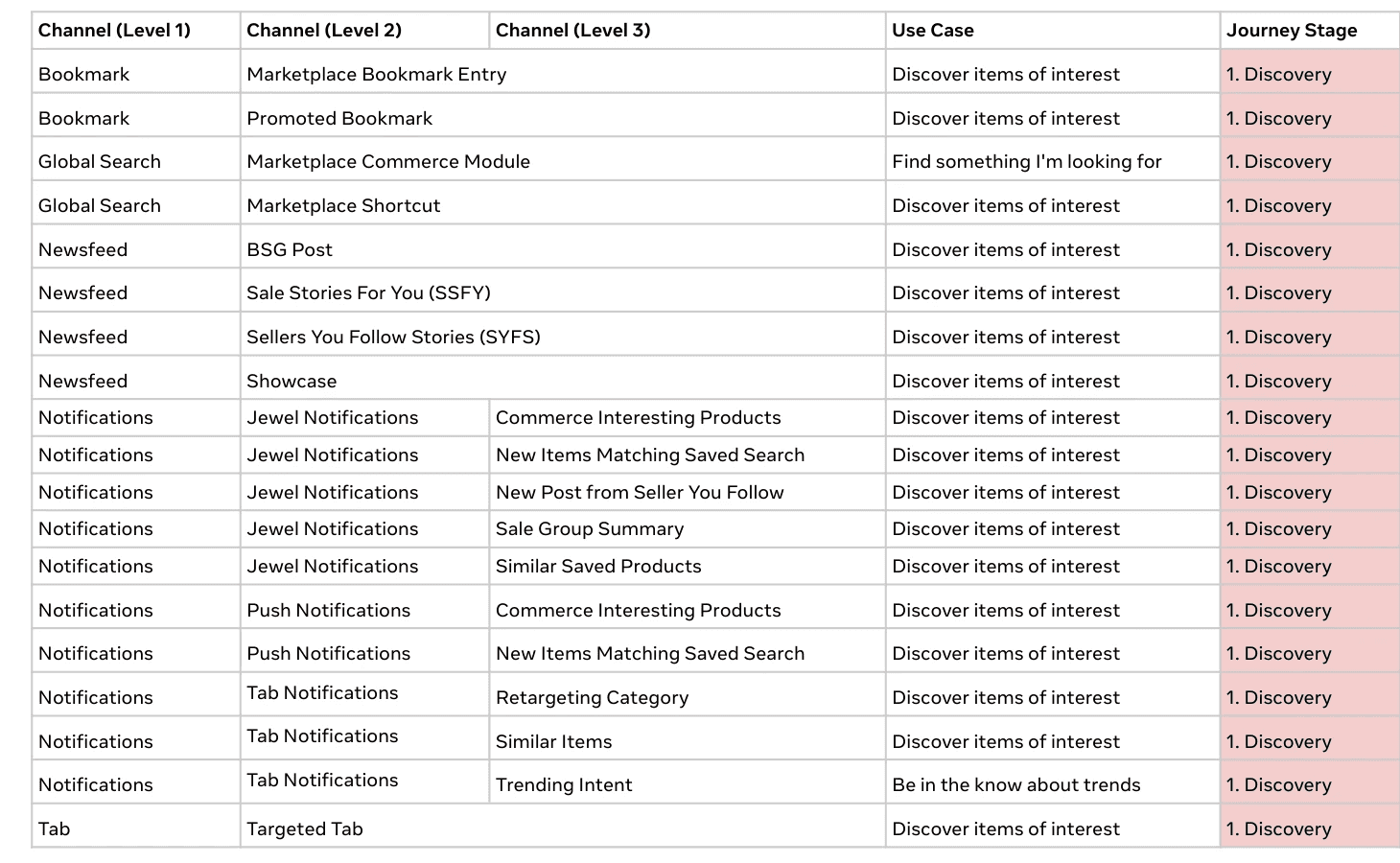
Marketplace already used many re-engagement tactics, with nearly 50 total permutations.
At a high level, Marketplace used five mechanisms to try to bring people back to the platform. Most had multiple-subtypes and often many use cases.
Including a Marketplace entry point in the global Facebook navigation bar
Including Marketplace entry points in the Facebook menu
Surfacing Marketplace results in the global Facebook search
Surfacing Marketplace-related content in the Facebook feed
Sending out notifications through multiple channels (e.g., within the Facebook app, mobile push notifications, email, etc.)
Below are a few examples of re-engagement channels in the front-end UI.
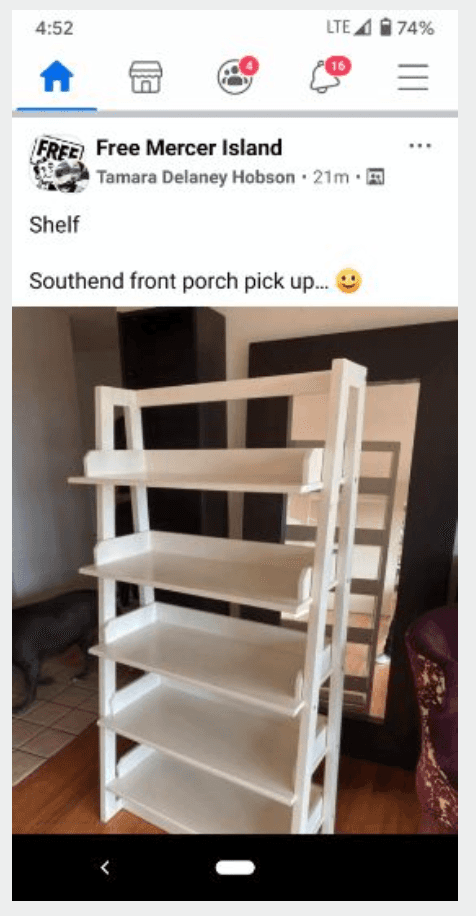
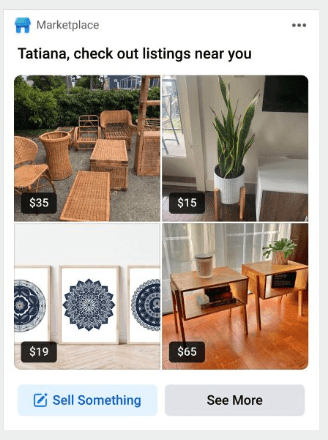
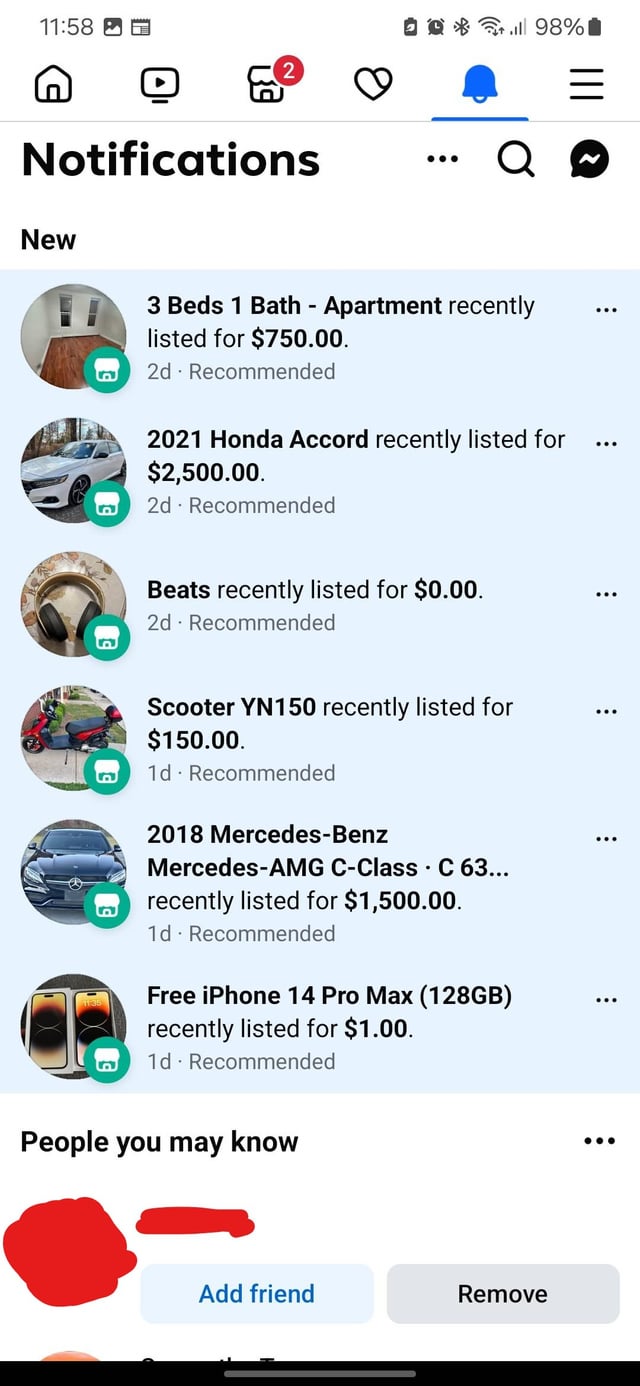
Re-engagement targeted shoppers based on a wide spectrum of intent signals (including lower intent signals) and focused disproportionately on the Discovery phase of the shopper journey.
Higher intent signals indicated greater confidence that a user was truly interested in an item (e.g., saving a search, setting a listing alert, saving a listing, messaging a seller about a listing, etc.) Lower intent signals provided less confidence in a user’s interest (e.g., viewing a listing). Of the nearly 50 re-engagement tactics Marketplace currently used, the majority fell into the Discovery phase of the shopper journey (i.e., trying to help shoppers find items they might be interested in), followed by Fulfillment, Post-Fulfillment, Consideration, and Transaction phases.
Note: for NDA reasons, metric data has been omitted from the image below.
Competitor Audit
Competitors like eBay, Etsy, and Mercari re-engaged customers by advertising deals and promotions.
By contrast, Marketplace (at time of study) did not do advertise deals and promotions. Rather, Marketplace notified shoppers about price drops for specific items - which brings up an important point about cost. Prior research had shown that the primary value proposition for shopping on Marketplace was to find a good deal, and that shoppers thought of cost holistically (e.g., shipping cost). However, Marketplace did not notify shoppers of more subtle cost changes to items (e.g., shipping cost, bundles, etc.). This represented an additional opportunity.
Analytics Review
Not all re-engagement tactics were equally effective.
Click-through rates (CTR) were highest for re-engagement tactics later in the shopper funnel (e.g., related to transaction and fulfillment of shipped orders). This is supported by earlier insights about intent and relevance. By contrast, other re-engagement tactics had lower CTRs, but competed for the same user’s limited attention. This offered opportunities for prioritization (see Recommendations below).
Recommendations
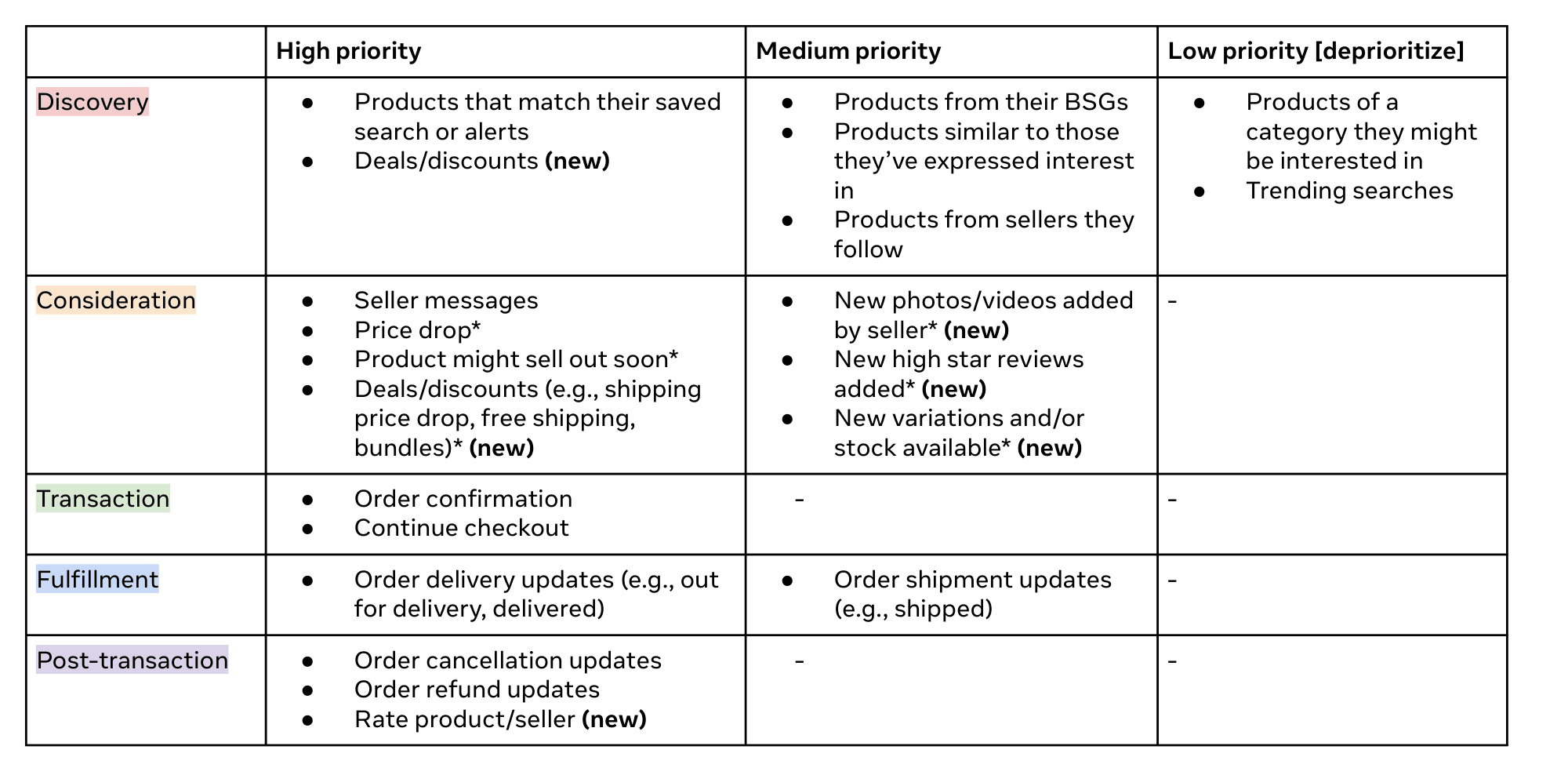
I pulled together all of the insights into a cohesive set of recommendations for the team, to guide re-engagement strategy. At a high level, these recommendations were to:
Prioritize re-engagement based on high-intent user signals, especially for Discovery and Consideration phases.
Deprioritize use cases that target based on low-intent user behaviors.
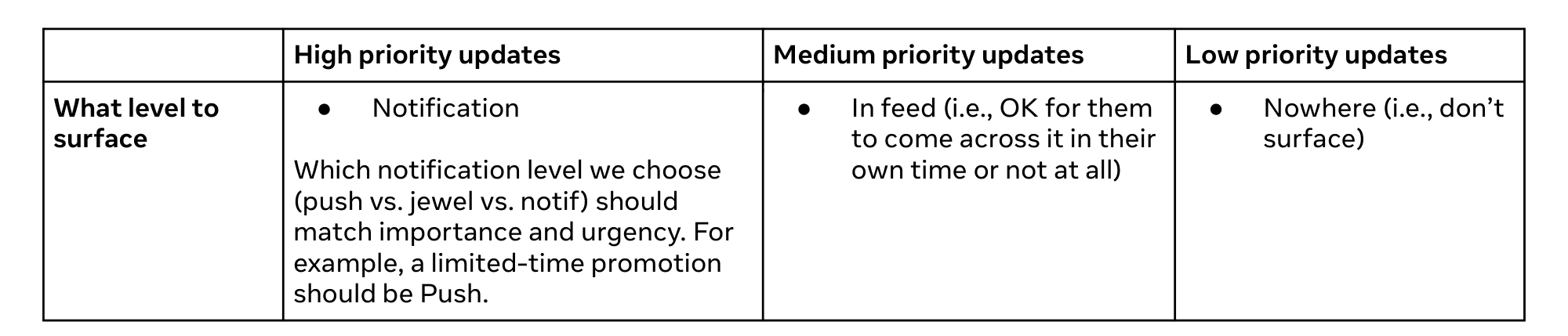
Surface information at the appropriate level based on urgency (showing the most important information - e.g., updates about items users have truly expressed interest and intent in - at the highest level).
Start new re-engagement use cases based on cost: 1) deals and promotions, 2) changes to cost for listings a user has expressed interest in.
Encourage buyers to leave reviews for sellers, to build trust in ecosystem.
Avoid redundancy unless critical.
I provided tangible, concrete prioritizations to guide the team's work; namely, a prioritized list of use cases for re-engagement (first table below), user signals (second table), and level at which to surface messages (third table).

Impact
This work had multiple layers of impact. Firstly, it established a shared understanding of the different ways we re-engaged shoppers today. Secondly, it was used to guide roadmap planning. While I moved off the team shortly after delivering the results, I would ultimately measure the success of the project based on product changes that were implemented and the number of users successfully re-engaged after the changes.